

PHONENICIAN



The Development of the Hebrew Writing System
The Phoenician writing system is one of the most influential scripts in history, not because it survived into modern use, but because its structure reshaped how writing systems were conceived. Developed in the eastern Mediterranean during the late second millennium BCE, Phoenician introduced a streamlined and highly adaptable approach to writing that would form the basis of many later alphabets.
Phoenician writing represents a shift away from complex, symbol‑heavy systems toward abstraction and efficiency.
Origins and Simplification
Phoenician script evolved from earlier Semitic writing traditions, which themselves were influenced by adaptations of Egyptian hieroglyphic principles. What distinguished Phoenician was its radical simplification of writing into a small, fixed set of symbols.
Key characteristics included:
- approximately twenty‑two symbols
- each symbol representing a consonant
- no direct marking of vowels
- consistent right‑to‑left direction
This design reduced the cognitive and practical burden of writing, making it easier to learn, reproduce, and transmit.


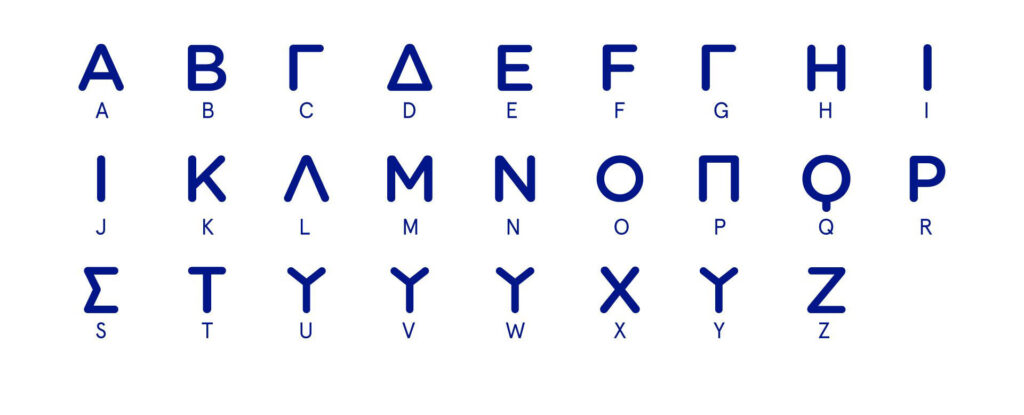
Writing for Movement and Exchange
Phoenician society placed a strong emphasis on trade, navigation, and contact across cultures. The writing system reflects these priorities.
Phoenician script was:
- linear and easily written on varied surfaces
- not tied to monumental or religious contexts
- flexible enough to be adopted by non‑native users
Rather than remaining a ceremonial or elite script, Phoenician writing traveled alongside merchants and settlers, spreading widely throughout the Mediterranean region.
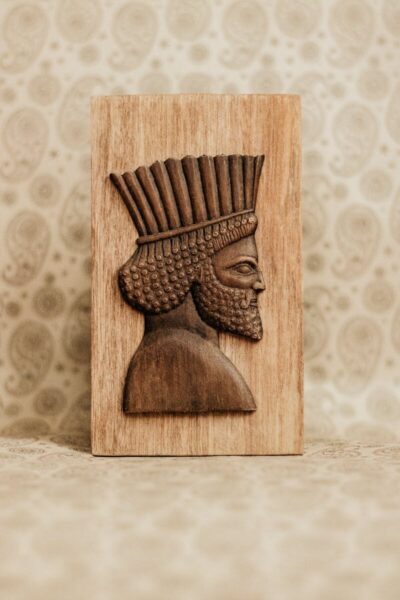
The Consonantal Alphabet as a Structural Idea
Phoenician’s most enduring contribution was not its letter shapes, but its structural concept: the consonantal alphabet as a modular system. Writing no longer depended on large symbol inventories or pictorial representation, but on recombining a small number of abstract signs.
Although vowels were not written, the system was sufficient for readers who knew the language, allowing speed, efficiency, and adaptability to take priority over phonetic completeness.
Legacy and Script Lineage
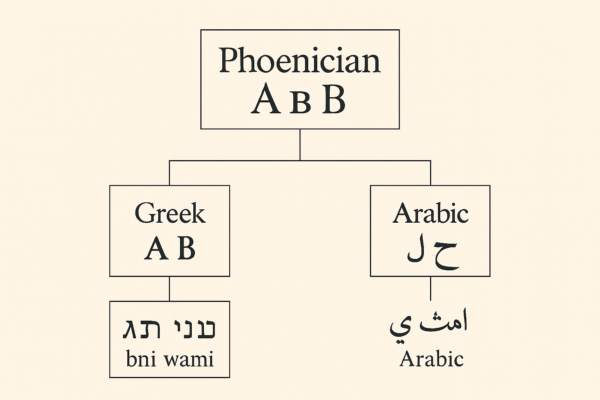
Phoenician writing eventually fell out of everyday use, but its influence expanded dramatically through adaptation. Neighboring cultures borrowed the structure of the script and reshaped it to suit their needs.
From Phoenician emerged:
- Greek, which introduced explicit vowel symbols
- Hebrew and Aramaic, which retained consonantal structure
- Arabic, through later Semitic development
- Latin, via Greek and Italic intermediaries
Through these descendants, Phoenician underlies many modern writing systems, even where the visual forms are no longer recognizable.a vehicle for preservation rather than innovation..

If you want to learn more about scripts and their orgins, visit our friends at