


J. R. R. Tolkien did not begin by inventing stories. He began by inventing scripts.
For Tolkien, writing systems were not decorative additions to a fictional world—they were structural foundations. He treated scripts the way historical cultures did: as tools shaped by material, history, and use. Understanding how Tolkien developed Elvish writing systems reveals why they feel inhabited rather than invented.
Scripts First, Stories Later
Tolkien was a philologist by training, deeply familiar with the histories of real writing systems. When he began creating Elvish, he approached it as a historical process, not a singular act of design.
Rather than asking what should Elvish look like?, he asked:
- Who would use this script?
- What would they write with?
- What values would shape how they write?
From the beginning, Tolkien treated scripts as cultural artifacts, not neutral encodings of speech.



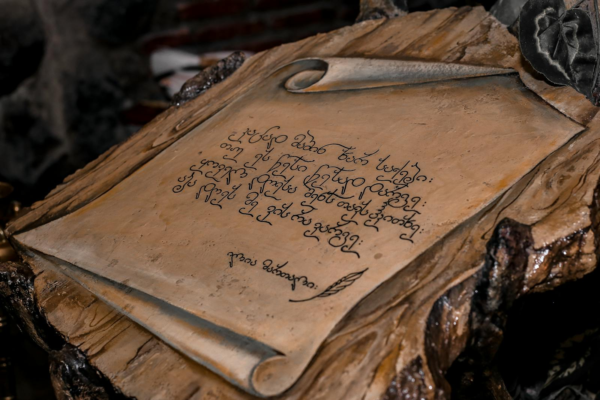
Purpose Shapes Form
Tolkien created multiple Elvish scripts because he believed different contexts produce different writing systems.
- Tengwar was designed for elegance, flexibility, and skilled writing. Its flowing forms suit pen and ink and lend themselves to poetry and literature.
- Cirth was angular and simplified, designed to be carved into stone or wood, suitable for inscriptions and durable markings.
These scripts did not compete—they served different needs. In this way, Tolkien mirrored real script history, where form follows material and purpose, not aesthetic whim.
Internal Logic Over Decoration
One of Tolkien’s most distinctive moves was giving his scripts internal structure.
In Tengwar, characters are not arbitrary shapes. Related sounds are represented by related forms. Small changes in stroke placement or orientation correspond to meaningful differences, creating visual families within the script.
This approach reflects a key Script Looms principle: writing systems become coherent when pattern replaces ornament. Tolkien’s scripts feel learnable because they are systematic.
Built‑In History
Tolkien rarely presented his scripts as static. Instead, he imagined them with:
- older and newer forms
- regional variants
- differing conventions across cultures
Some Elvish peoples preferred one script over another. Others adapted scripts for new contexts. This layering created the illusion of centuries of use—even though the scripts were designed by a single person.
Real writing systems survive this way: through adaptation, borrowing, and uneven change. Tolkien did not just design scripts; he gave them pasts.


Adaptation Without Redesign
Importantly, Tolkien did not redesign his scripts every time they were used differently. Instead, he allowed:
- the same script to represent multiple languages
- different conventions to emerge for the same symbols
- irregularities to remain
This restraint is why his scripts feel authentic. Real scripts are rarely optimized—they persist through habit and inheritance. Tolkien understood that imperfection is a mark of longevity.
Use as Validation
Tolkien constantly used his scripts: in manuscripts, maps, illustrations, and marginal notes. Through use, he discovered what worked and what didn’t.
This mirrors the historical reality that writing systems stabilize through repetition, not theory. A script becomes real not when it is complete, but when it can be reused without thought.
