

SWAHILI



The Development of the Swahili Writing System
The Swahili writing system reflects a history of cultural contact and script transition rather than internal alphabet design. Over time, Swahili has been written in more than one script, demonstrating how writing systems can change independently of the language they represent.
Unlike scripts that evolve gradually from earlier forms, Swahili writing developed through the adoption and adaptation of existing scripts to meet new social, religious, and administrative needs.
Early Use of the Arabic Script
For centuries, Swahili was written using the Arabic script, adapted to represent a language structurally different from Arabic. This writing tradition developed through long‑standing trade, scholarship, and religious exchange along the East African coast.



Arabic script was modified through:
- additional marks and conventions
- creative reuse of existing letters
- reliance on context for interpretation

Written Swahili in Arabic script was used for poetry, correspondence, historical records, and religious texts. This system emphasized continuity with Islamic literary culture rather than precise phonetic transcription.
Transition to the Latin Script
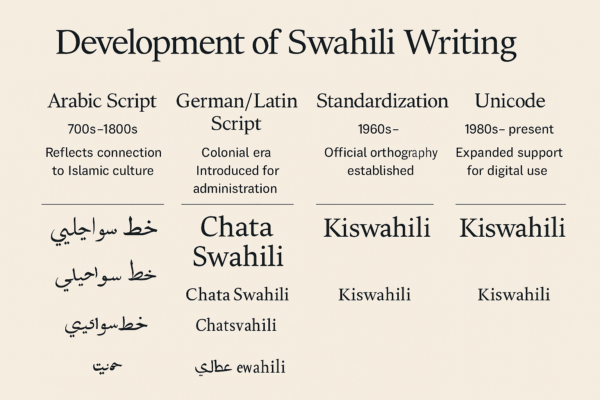
During the 19th and early 20th centuries, European colonial administration and missionary activity introduced the Latin script for Swahili. The shift was motivated by practical considerations such as education, printing, and governance rather than by structural superiority.
The Latin alphabet offered:
- clearer representation of Swahili sounds
- easier standardization
- compatibility with printing and later digital technologies
Over time, the Latin script replaced Arabic script in most public and institutional contexts.
Standardization and Modern Form
In the 20th century, Swahili orthography was standardized using the Latin alphabet. The system emphasizes regular letter–sound correspondence and avoids extensive use of diacritics, resulting in a writing system that is relatively transparent and consistent.
The modern Swahili writing system:
- uses the Latin alphabet with minor adaptations
- favors clarity and ease of learning
- supports wide regional and international use
Arabic‑script Swahili remains historically significant but largely ceremonial today.

If you want to learn more about scripts and their orgins, visit our friends at