
HANGUL



The Development of the Hangul Writing System
Hangul is a rare example of a writing system that can be traced to a specific moment of intentional design. It was created in the 15th century in Korea as a response to the limitations of existing writing practices and with the explicit goal of improving accessibility and literacy.
Unlike most scripts that evolved gradually over centuries, Hangul was conceived as a coherent, internally logical system from the outset.
Creation and Purpose
Hangul was promulgated in 1446 under the reign of King Sejong. At the time, written Korean relied heavily on Chinese characters, which were complex and required extensive education to master. Hangul was introduced as an alternative that could accurately represent Korean sounds while remaining easy to learn.
Its creation marked a shift in how writing systems could function—not only as inherited traditions, but as deliberately engineered tools.

Featural Design
Hangul is classified as a featural alphabet, meaning that the shapes of its letters are not arbitrary. Consonant forms are based on the physical position of the speech organs used to produce the sounds, while vowel forms are constructed from simple geometric elements.
This design allows related sounds to share visual features, making the system transparent and systematic. Letters are combined into square syllable blocks, giving Hangul a rhythmic, modular appearance that differs from linear alphabets while maintaining phonetic clarity.
Use, Resistance, and Survival
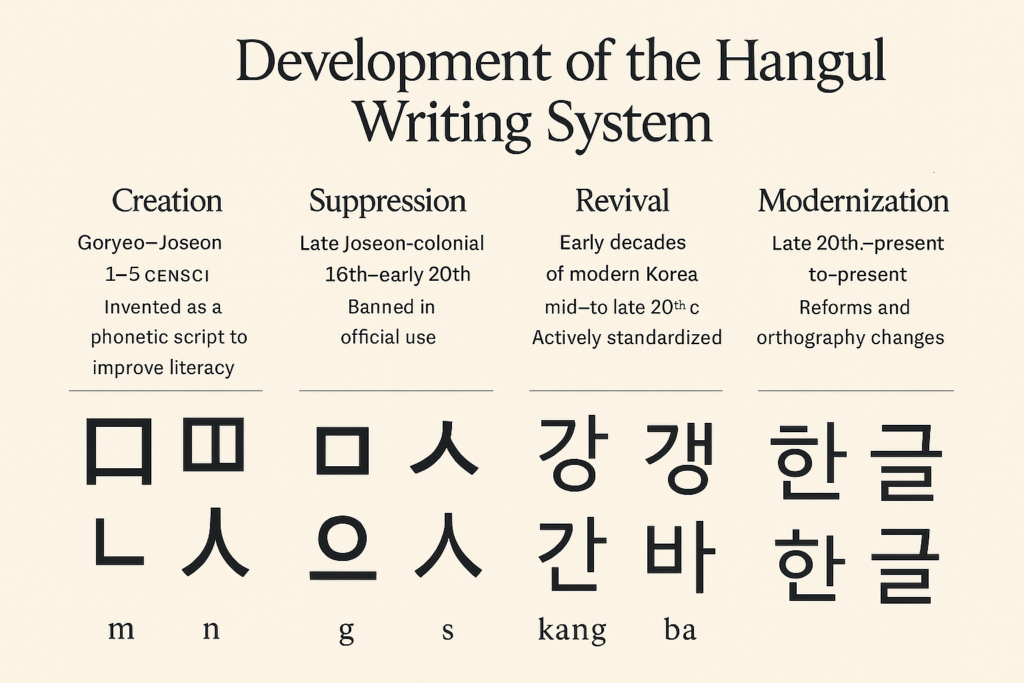
Despite its clarity, Hangul was not immediately adopted as the primary script. For centuries, official and scholarly writing continued to favor Chinese characters, and Hangul was often used in informal, personal, or marginalized contexts.
Nevertheless, Hangul persisted through everyday use, preserving its original structure even as its social status fluctuated.
Standardization and Modern Use
In the 20th century, Hangul was standardized and promoted as a national writing system. Orthographic conventions were clarified, and the script became fully integrated into education, publishing, and digital technology.
Remarkably, Hangul remains largely faithful to its original design. While typography and usage have evolved, its foundational principles have changed very little, demonstrating the durability of intentional system design.

If you want to learn more about scripts and their orgins, visit our friends at