

French



The Development of the French Writing System
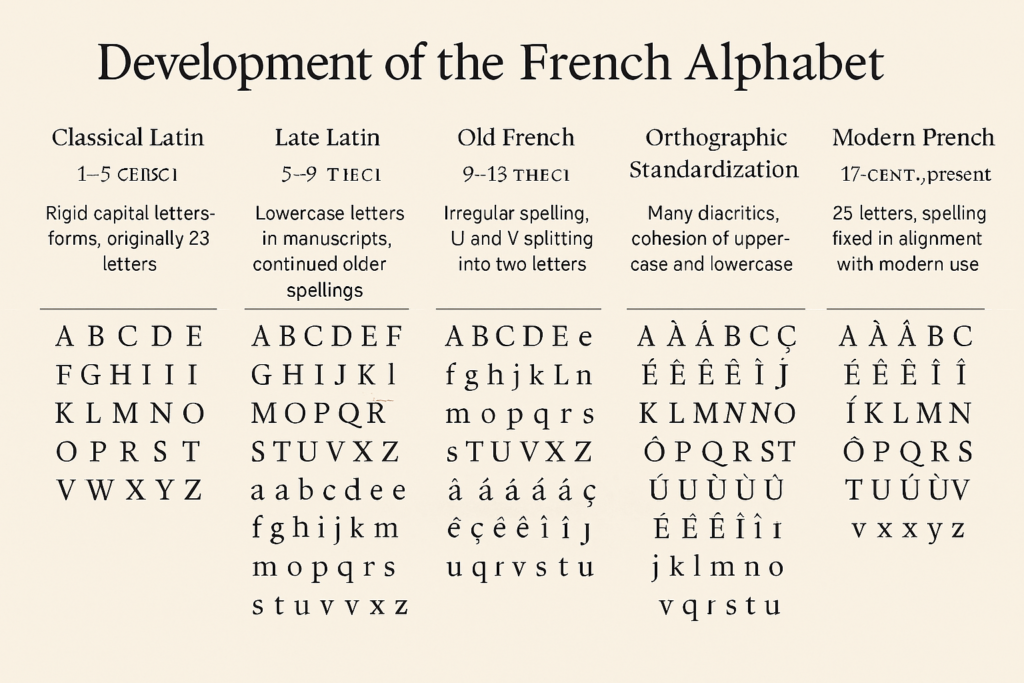
The French writing system is based on the Latin script, but its appearance and behavior reflect centuries of preservation, standardization, and historical layering. Rather than reshaping the alphabet to follow changing pronunciation, French writing retained older forms and developed graphic conventions to manage change.
As a result, French writing functions as a historical record as much as a phonetic system.

Latin Origins and Early Adaptation
French writing emerged from Vulgar Latin, written using the Roman alphabet. Early French texts reused Latin letters without expanding the alphabet significantly, even as pronunciation diverged from Latin speech.
During this period:
- the Latin alphabet remained largely intact
- spelling varied widely by region and scribe
- writing preserved Latin letterforms long after spoken sounds shifted
The alphabet served as a stabilizing structure rather than a flexible phonetic tool.
Medieval Manuscripts and Orthographic Layering
In the medieval period, French writing developed within a manuscript culture shaped by monasteries, courts, and administrative centers. Scribes retained many Latin spelling conventions, even when they no longer reflected pronunciation.
This led to:
- silent letters
- multiple spellings for the same sounds
- visual distinctions tied to meaning or grammar rather than sound
The alphabet itself did not expand; instead, new conventions accumulated around it.
Diacritics and Meaning Preservation
One of the defining features of French writing is its use of diacritics, not to alter the alphabet but to refine how letters function.
These marks:
- distinguish homographs
- preserve traces of lost historical letters
- signal grammatical or semantic differences
Rather than simplifying spelling, diacritics allowed French writing to retain historical form while increasing precision.


Standardization and Institutional Control
AsWith the rise of printing and later the influence of the Académie Française, French orthography became strongly standardized. The alphabet settled into its modern 26‑letter form, and spelling reforms were limited and conservative.
This cemented French writing as:
- visually stable
- historically conservative
- resistant to phonetic regularization
The system prioritized continuity and authority over ease of reform.




If you want to learn more about scripts and their orgins, visit our friends at