

HEBREW
The Development of the Hebrew Writing System
The Hebrew writing system is a consonantal script (abjad) with a long history of continuity and preservation. Its development reflects an emphasis on structural stability, with adaptations layered onto an existing framework rather than changes to the alphabet itself.
Hebrew writing demonstrates how a script can remain visually recognizable across millennia while expanding how it is read and interpreted.

Origins in Phoenician Writing
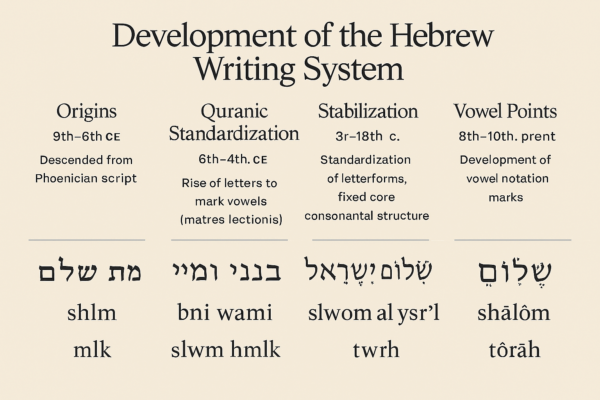
Hebrew script traces its origins to the Phoenician alphabet, an early Semitic writing system that represented consonantal sounds using a small, ordered set of symbols. By the first millennium BCE, a distinct Hebrew script had emerged, written from right to left and consisting solely of consonants.
Early Hebrew writing relied heavily on reader knowledge and oral tradition. Meaning and pronunciation were supplied through familiarity with the language rather than explicit graphic cues.






Consonantal Structure and Reading Practices
Hebrew writing is built around consonantal roots, with vowels implied by word patterns and context. To assist readers, certain consonants gradually began to serve secondary roles as vowel indicators. This preserved the script’s consonantal foundation while improving readability.
The alphabet itself remained unchanged, reinforcing continuity rather than adaptation through expansion.
Stabilization of Letterforms
IOver centuries of manuscript copying, Hebrew letterforms became increasingly standardized. A square, block‑like style became predominant for formal and religious texts, creating a consistent visual identity that remains in use today.
This stabilization ensured:
- consistent letter shapes
- fixed letter inventory
- strong visual continuity across regions and time
The script functioned as a vehicle for preservation rather than innovation.
Development of Vowel Pointing

Between the 8th and 10th centuries CE, a system of vowel points (niqqud) was developed to indicate pronunciation more precisely. These marks were added around consonants without altering the alphabet itself.
Vowel pointing allowed Hebrew writing to:
- support accurate reading and teaching
- preserve traditional pronunciations
- remain flexible across contexts
In most everyday modern writing, these markers are optional and omitted.
a vehicle for preservation rather than innovation..

If you want to learn more about scripts and their orgins, visit our friends at